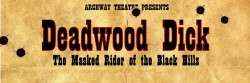
“Deadwood Dick”
One of the things I like best about my son is that he makes me think. In the last two conversations I’ve had with him, the main topic has been a couple of auditions he’s had and I’ve come away from our discussions pondering language usage, racism and recidivist history.
The plays involved are “To Kill a Mockingbird” and “Deadwood Dick” – the first based upon Harper Lee’s 1960 novel of the same name and the second based on a fictional character who appeared in a series of dime novels published between 1877 and 1897 by Edward Lytton Wheeler. “Mockingbird” is known for its humor and warmth despite dealing with serious issues of race and inequality. “Deadwood Dick,” on the other hand, is a lusty adventure-filled melodrama whose characters are more like comic book caricatures.
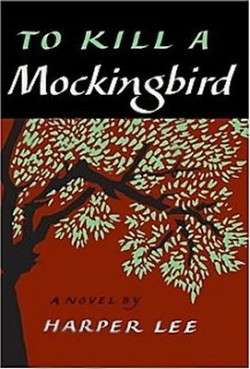
“To Kill a Mockingbird”
In the parts that Charlie auditioned for – the racist, accusing father of the girl who was presumably raped in “Mockingbird” and the bombastic southern judge in “Deadwood Dick”—there are demeaning words used by the characters – words that are not only considered politically incorrect but that are recognized as racist in the extreme by today’s standards. Charlie feels strongly that using those words – putting them out there in the atmosphere – perpetuates the racist concepts on which they are based. I agree with him.
On the other hand, the words are accurate usage given the time and setting of each story. Deleting them from the script or substituting other, less controversial, language would give a false impression of the historical context — right up there with the sanitized version of history with which most of us were presented in the textbooks of our school days. How do we portray the sensibilities of past generations accurately without perpetuating their biases, even inadvertently? And how many of our own biases are creeping in – those ‘accepted’ truths that we neither notice nor question?
Charlie and I didn’t come to any definitive conclusions about any of it, but the discussions were thought provoking and will no doubt be revisited. They are topics I often deal with in my own historical research and writing. I have to say that I’ve never given much thought to the struggles of conscience an actor might have with some of those same situations. As I say… I love it that my son makes me think!
Sydney: You write that your son makes you think. Might this be because your son is a thinker? And what might be the connection between this thinker and the mother who raised him to think?
Sydney, Right on about the sanitized textbook versions of history we had to contend with! Of course, at the time we didn’t know any different. Who did? I often wonder. Yep, our off-spring make us think. What a blessing! Well, sometimes not!
You can’t excise the N-word from “To Kill a Mockingbird” without diluting its condemnation of the racism of that time. In “Deadwood Dick” racist terms were used casually in two cases, and were easily substituted without changing anything about the play.