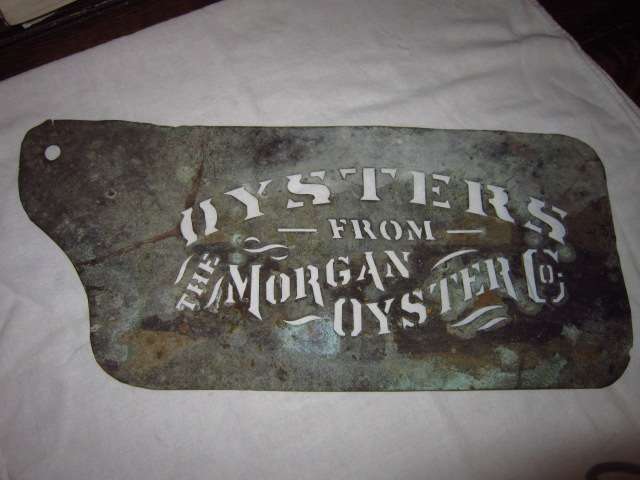
Oyster Box Stencil c. 1870
Two men whom I greatly respect and admire have admitted to me lately that they have serious stencil envy regarding my Morgan Oyster Company box-labeling stencil, circa 1870. Both men are my friends, both are collectors and to both I’ve smiled sweetly and just said “no.” One stencil coveter is my neighbor, Tucker Wachsmuth; the other is our fearless Observer editor, Matt Winters.
Tucker, of course, has seen the stencil and mentioned early on that if I were to think of divesting myself of it, he would be happy to take it off my hands. Matt on the other hand, read my recent blog about said stencil and sent an email with “Envious…” as the subject line. He said in that communication that he had just purchased some 19th century Morgan rectangular oyster cans that were found down at the bottom of abandoned Colorado silver mine.

One Pound Can, Front
Yesterday both Matt and I had occasion to share our Morgan Oyster Company artifacts at the Community Historian Class and, now that I have seen the cans up close and in person (and even carefully fondled them) I think that I can safely say that I have serious “can envy,”
The larger of the two measures approximately 7 x 41/2 x 2 inches and would have been a one-pound can, though this would have been ‘understood’ rather than stated on the can, itself. It was, after all, way before FDA labeling standards. The smaller, half-pound can measures 4½ x 4½ x 2. Each would have held dozens of the little native oysters which, even in their shells, were no bigger than a silver dollar. Matt told us he had once estimated that a pint jar could hold 200 shucked native oysters!

Half Pound Can, Back
Seeing the cans put a very clear light on the oft-told story that the native oysters sold for a dollar apiece in gold-rich San Francisco of the 1850s and ‘60s and that a plate of the little delicacies fetched $50 at the gourmet restaurants in those days of the 49ers.
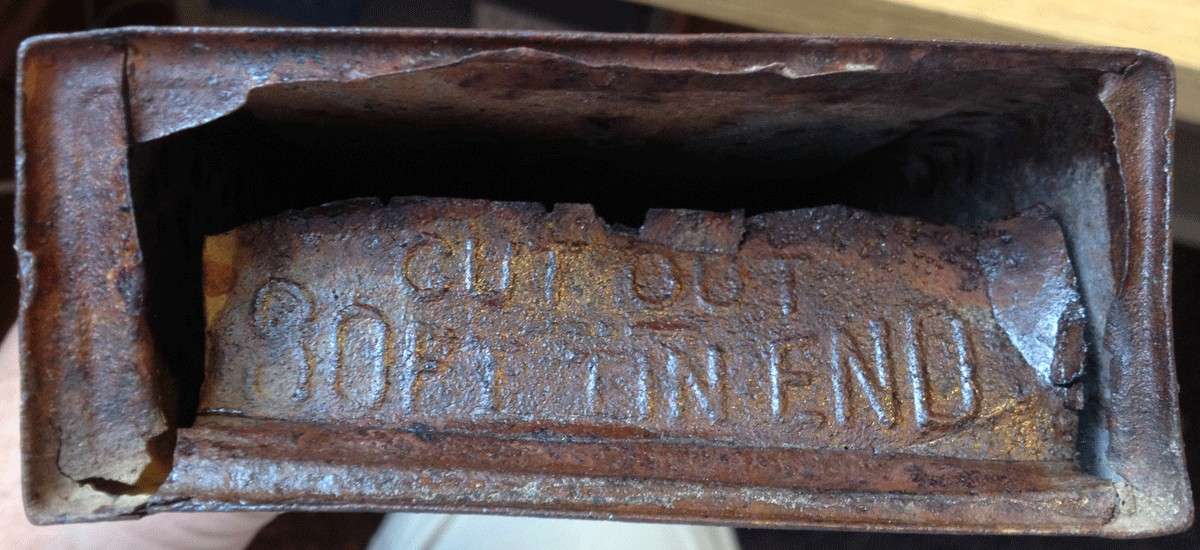
The End to Open
Matt also pointed out that, though the cans were lined with tin (much as high-end copper cookware is today), the joins on the cans were soldered together with lead. We also speculated about what the “fresh” label meant and concluded that the oysters were probably lightly steamed during the packing process. At the end of each can (the equivalent of today’s “open here” part) was made of a very thin tin that could easily be breached with a pocket knife – a handy snack pack during a hard day of panning gold.

Native Oyster Shells
Once again I was impressed at how an artifact (or a diary or any other primary source material) can illuminate the past in a way that no amount of reading in a dry old history text can do. Hooray for the collectors and keepers and especially for the museums that not only collect and keep but also conserve and display! And a special thanks to the Columbia Pacific Heritage Museum for sponsoring the Community Historian Project! I’m so glad to be a part of it.
Gotta love those oysters and all that went with them.
More rich history!