
Hawthorn in Nahcotta
Nahcotta isn’t all that far south of Oysterville – just four miles – but somehow the Hawthorn trees there manage to bloom a week or so before ours get going. They are out in all their glory right now and we took a special excursion yesterday to get a photograph or two and give a silent salute to Captain James A. Scarborough.
Scarborough was an Englishman – born in 1805 in Ilford, County Essex. When he was twenty-four, he joined the Hudson Bay Company and first crossed the Columbia River bar aboard the Isabella in May 1830. He worked for Hudson Bay Company for the next twenty years and, despite reports that his men did not respect him and that he was overly fond of demon rum, he received frequent promotions.
When he was thirty-eight he married Ann Elizabeth, a Chinook woman, and together they established a farm on Chinook Point where Chief Comcomly and his six wives had once lived. The area became known as Scarboro Hill. When Congress enacted the Donation Land Law in 1850, James and Ann filed for the land they had been living and working on. They ended up with 643 acres extending about a mile along the north bank of the river and including all of Chinook Point and most of Scarboro Hill.
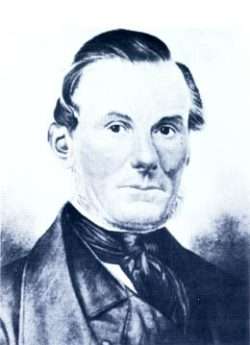
Captain James A. Scarborough, c. 1850
Having put in his twenty years for HBC, he retired (or was dismissed, according to some reports), moved permanently to his land claim and, until his untimely death, devoted himself to farming, commercial salmon fishing, and piloting mail steamers over the Columbia River Bar. Scarborough’s farm prospered. He was fond of plants and set out many fruit trees as well as other ornamental and useful trees and shrubs.
Scarborough died in 1855 (two years after his wife’s demise) under somewhat mysterious circumstances — there were rumors of poison. There was also talk of a stash of gold ingots, supposedly buried on Scarboro Hill. The treasure has never been found but, unbeknowst to most of us, the captain left behind enduring riches.
About 1848, even before he was living there full time, Scarborough planted a Hawthorn tree on the slopes of his hill. According to all accounts, it was an absolutely magnificent specimen and, for almost half a century, it was used as a local landmark and navigation guide. When in 1897, in preparation for the establishment of Fort Columbia the following year, the Army cut down the tree, there was a public outcry that could be heard throughout Pacific County and even across the river. Locals flocked to Scarboro Hill, took slips from the tree, and many resultant Hawthorns still thrive throughout the area.
Here’s to Captain Scarborough and his magnificent hawthorn! And to all their descendants, as well!
What a wonderful thing to learn about — thank you, Cuz! And to think I drive by Scarboro Hill three times a week and Didn’t Even Know! So GOOD to be related to a historian (especially this one!)
Such a fabulous history lesson Sydney. Thanks, I will be on the lookout for a certain Hawthorne tree on my next visit in June!