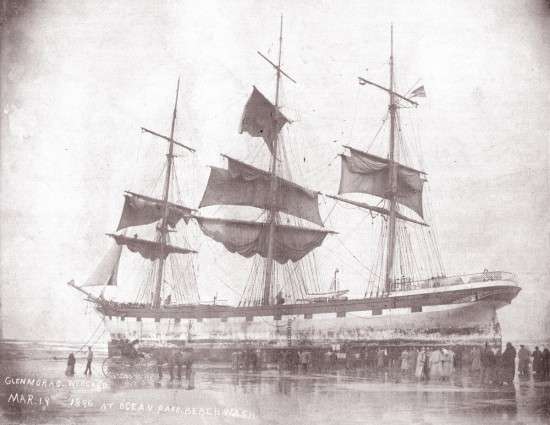
- Glenmorag, 1896
One of the most interesting jobs in the history of our county was that of Wreckmaster. It was an elected position established as one of the first acts of the first session of the Territorial Legislature of Washington in 1854. The law established the elective office of Wreckmaster in the water-edged counties of Pacific, Chehalis (Grays Harbor), Thurston, King Jefferson, Island and Whatcom. In 1859 an additional act added Wreckmasters for three more counties, Pierce, Kitsap and Clallam.
One of the few descriptions of an early Wreckmaster’s duties appears in the Summer/Autumn 1979 issue of the Sou’wester in an article by Steve Meriwether:
In the county elections of 1855, John Edmonds Pickernell was elected Pacific County Wreckmaster. John was responsible to make a list of the many ships destroyed each year on the treacherous bar of the Columbia and along the beaches and to see to the burial of lost hands.
It was also the Wreckmaster’s duty to assume charge of any marine wreck after it had been abandoned and to save all of it that was possible for the benefit of the owners. He was charged with protecting wrecks and their cargoes from the “seagulls,” a local term that referred to people who helped themselves to treasures that littered the beach after a shipwreck.
That was a difficult job, especially in the days before adequate roads and rapid means of transportation. The “seagulls” or scavengers often arrived at the beach well before the Wreckmaster could get there to secure the area. On the peninsula, stories are legion concerning the prizes gleaned from early shipwrecks.
Wreckmasters were elected for a term of three years and were required to post a bond with the local court. In the course of their duties they could find themselves in charge of very valuable properties. They were entitled to “a reasonable allowance as salvage for their services, and to all expenses incurred by them in the performance of such services, out of the property saved…”
Although the name “Wreckmaster” lent itself to joking, there is no doubt that “guarding the private and public interests against piracy as related to shipwrecks and salvage” was a serious problem in the early days. The original Act was lengthy and detailed, covering six pages – a clear indicator that early lawmakers felt a need for immediate legal protection of “shipwrecks along the waterways, as well as any goods, wares and merchandise cast by the sea upon the land.”
The last time the office of Wreckmaster appeared on the ballot was 1914. Increased population in the Territory, eventual expansion of the federal services – Life Saving, the Coast Guard and other programs of law enforcement – phased out the need for a local official to carry out these duties. And so ended one of the more colorful aspects of Pacific County governance.
Fascinating, “seagulls” is a very descriptive term for the gleaners arriving before the “wreckmaster”.
A job much to be envied by all us junkers. Garage and estate sales and thrift stores just don’t have the same zip.
It must have been fascinating to have actually heard from the men who were elected to these posts of Wreckmaster for those 60 – some years!
The lives of the “seagulls ” capture the imagination as well. Certainly a different facet in our history.
One can imagine that the stories must have been gruesome and fabulous and heart-wrenching.
It sounds like the basis of a novel bit of fiction, the right combination of mystery and greed, pathos and adventure… it’s a bit surprising it hasn’t been done yet.