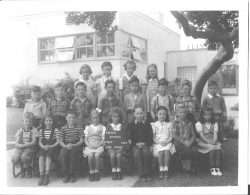
2nd Grade Sydney, front row middle with sign, – 1943
As a kindergartener in the fall of 1941, I was blissfully unaware of the turmoil that must have been happening at Edison Grade School in Alameda, California. Only in later years did I realize that our classes became crowded because of the people coming in to work in the shipyards or that, for the first time ever, the school had a woman principal because all the male educators had gone to war.
And that was only the beginning. It became the norm that women worked outside the home and families needed to cope with after-school child care. Children were expected to take on some of the home responsibilities and, often, contributed to the household finances by delivering newspapers or baby-sitting or mowing lawns.
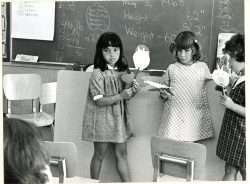
Second Grade Puppet Show, Southgate School, 1962
By 1961 when I began teaching, myself, class sizes in primary grades were 30 to 35 childen. “Individualized instruction” was a concept yet unheard of. There were no provisions for special needs students — they “sank or swam” in the regular classroom — or weren’t sent to school at all. There were no teaching assistants or classroom aides, no specialists in reading or math or physical education. In fact, kids got their “exercise” during recess; P.E. was not yet a requirment and it took a few years before elementary schools began to incorporate John F. Kennedy’s 1961-62 Physical Fitness Program into their curricula.
Over the next forty years, until I retired in 2001, the changes in our schools continued — often faster than we educators could keep up. School became much more that the place to learn “the three R’s” and to prepare for higher education or for work in the “real world.” By the time I retired, much of our population depended upon schools to feed children their breakfast and lunch, to provide after-school programs to take care of child-care needs. In many places, local doctors and dentists volunteered to visit the schools, adding another, much-needed layer to the hearing and visual screenings done by the school nurse. “School” no longer was thought of as an academic institution. Schools now had far greater responsibilities within the community — far beyond their original mission of teaching reading, writing and arithmetic.

Oysterville Schoolhouse 2008
And now, educators find themselves between a rock and a hard place once again. My heart goes out to them. No matter what choices are made, the results won’t be perfect. And, the changes can’t be put into place gradually. The need is right now, ready or not. I send every teacher, every administrator, every person working in any capacity for our schools, my heartfelt thanks. Certainly there is no one “right” choice. Whatever your decisions, I hope our communities will give you their blessings and support! You are all saints!
0 Comments