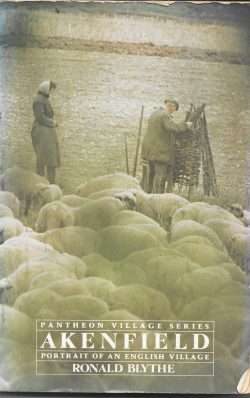
Akenfield by Ronald Blythe
The blurb on the back of the book I’m reading says, “You do not hear them talking; you hear them feeling…” I love that! And, it’s true. The book is Akenfield: Portrait of an English Village by Ronald Blythe. Written in 1967 and published two years later, it is a definitive look at life in an East Anglian village at the beginning of the second half of the twentieth century.
The table of contents reveals the scope of this amazing work which catches the memories of those who grew up in the era of horses, before anything in their lives was mechanized. The Introduction covers Population and Houses, Work in the Village, and Domesday for 1936 and 1966: the Second Agricultural Revolution. Twenty chapters follow:
1) The Survivors; 2) God; 3) The Ringing Men; 4) To be a Farmer’s Boy?; 5) Good Service; 6) The Forge; 7) The Wheelwright; 8) The Craftsmen; 9) The School; 10) The Agricultural Training Centre; 11) Officers and Gentlemen; 12) The Orchard Men; 13) Four Ladies; 14) The Young Men; 15) The Law; 16) Limitations 17) The Vet; 18) Not By Bread Alone; 19) The Northern Invaders; 20) The Hour of Death.
There are so many unexpected bits of information in the book – probably ‘useless’ information to most but, somehow, satisfying to me who would like nothing better than to step back in time for a few days to get a greater understanding of how life was here in Oysterville long ago, in my grandfather’s childhood. “The horses were friends and loved like men,” said one of the old Akenfield farmers. “The ploughmen talked softly to their teams all day long and you could see the horses listening.”
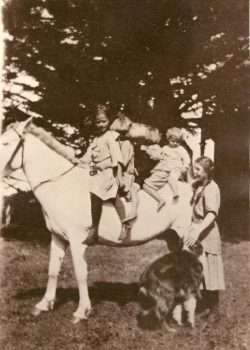
H.A.Espy Children on Danny, 1924
My grandfather would have understood that. When his last horse, Countess, died in 1944, Willard began his ‘Family Man’ column (in Good Housekeeping Magazine) by quoting Papa’s letter: “It was a relief for her to be gone,” he says (Countess was past thirty), but she wanted to live and so I wanted her to. She was the last animate tie to the old ranch, when you boys were on it with me.” Her death reminds him, he says, that he is lonesome and old.
Willard went on to say that the letter made him see a herd of four-legged ghosts – the horses Empress, Fanny and Prince, Blaze and Lassy and many of the cows as well. He remembered that when Papa got sick and had to give up the ranch, he had kept the animals that would not sell and they had died one by one. Countess was the last and only the summer before had become so feeble that she could not pull the harrow across the garden plot so Papa had unhitched her and pulled it himself.
I think I might have read Akenfield before – maybe thirty or forty years ago. There are phrases and, yes, feelings (as that blurb said) that I remember. Pleasant glimmers of a book and of a past almost remembered.
Wow how exciting. This is very similar to the story I am putting. Together about my grandfather from England. I feel just like I am there with him. I feel like I am right there in 1899.
We need to compare notes!