I think of the Red House here in Oysterville as being the one that has changed least in my lifetime, at least in feeling. Partly that’s true because it’s always been in the Espy family and changes to the furnishings and décor have been minimal for more than a century. Partly, also, is that there has only been one substantive change to the layout of the rooms, themselves, and that was when the downstairs bedroom was converted to a much-needed bathroom/laundry room.
 The bedroom was the one in which all the R.H. Espy Children were born. As early as 1946 when my Uncle Willard bought the house from the R.H. Espy Estate, there was talk of making that change. However, my grandfather and his brothers and sisters all objected for sentimental reasons. It wasn’t until the last of that generation (Uncle Cecil) died that the change was made.
I have a circa 1970 snapshot of Uncle Cecil sitting in the living ro om with the door ajar to the bedroom. Looking at it tugs at my heartstrings for it’s not only the configuration of the room that has changed. The lovely bedroom furniture, now in an upstairs bedroom,was once in our house.
It was my grandparents’ “bedroom suite” and my mother always insisted that they brought it up from California with them in 1902. However, the day of my grandfather’s funeral, Uncle Cecil and his son John came and took the entire bedroom set up the street to the Red House where they said” it belonged.” It was one of those ‘family issues’ that no one ever talked about but that no one has yet forgotten and, now, none of us know the truth of it. I’m not sure anyone did back then either.
That photograph reveals other wonders, as well. On the living room wall is a portrait of President Lincoln, always a hero in our family, and the frame is decorated with rosettes made by my great-grandmother Julia out of her old kid gloves. Also visible is a corner “whatnot shelf” that she made from empty spools of thread. I think those items are still there. They certainly are there in my mind, I’ll have to take a more careful look next time I visit.
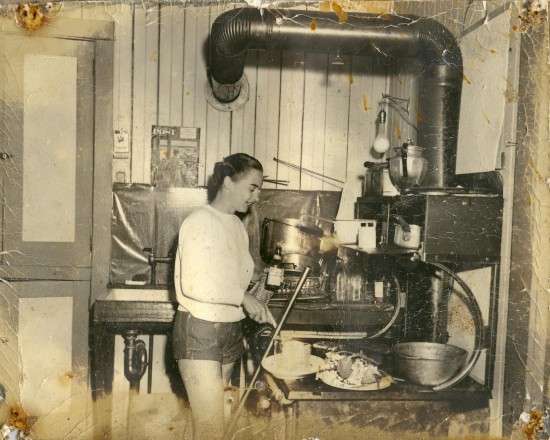 I have another photograph, taken about twenty years earlier, of my mother’s first cousin Barbara who was Uncle Cecil’s daughter. She is standing at the woodstove frying clams which is where I remember her being throughout my childhood! Of all the eighteen first cousins of that generation, she was the one I knew best and loved the most. I think my mother felt the same way.
That old stove is still in the house, too, but not in the kitchen. When the appliances were ‘updated’ (about 30 years ago now, I think), the stove was moved around the corner into the dining room and serves as a sideboard in its new location. Its back is snugged up to the same wall as it used to be – just in the next-door room.
Almost everything else in that clam-frying picture is the same – right down to the Saturday Evening Post cover on the wall that shows a similar kitchen scene. In fact, it’s so much like the photograph of Barbara, I sometimes fantasize that Norman Rockwell must have visited Oysterville…
I can’t help wondering how much change it takes to make a place or a person feel different. Or does it depend on the rapidity of the change? Or the fuzziness of memory? Or the buy-in to nostalgia? “Whatever…” as the kids say. I’m just happy to have the photographs!
I know we’ve chatted before about closeness to our grandmothers and how important their homes were to our childhoods, Sydney. When I drove down to Santa Cruz in 1993 to visit my critically ill grandmother, I stayed at her house, a house where I spent most of the summers of my childhood. Her only child, my father, had moved into it a couple of years before when my grandmother was sent to a “guest home” for seniors. In that time, he had completed some much-needed remodeling. That was the first time I had seen the remodeled house. As nicely done as his work was, I couldn’t help but start crying one night because of the major changes wrought. Anyone who undersestimates the possibility of a connection to “place” must not have experienced it.