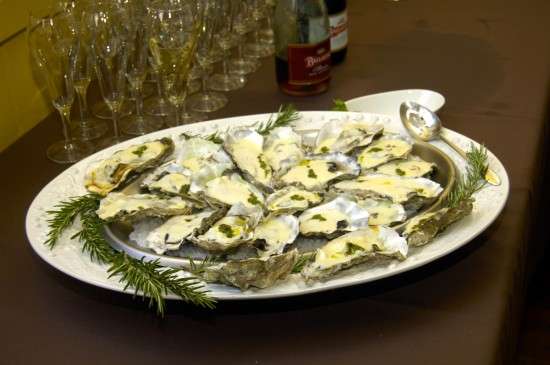
- On The Half Shell
According to the newspaper, our friend Dan’s problems with the county seem to be continuing. If I understand it correctly, at least one of the many ‘health violations’ listed has to do with taking oysters directly from the bay, offering them for sale in the shell, and returning the unsold, unopened bivalves to their tidal homes.
I’m not sure why that is wrong. It seems to me that oysters would remain happier and healthier in the bay than in a refrigerator or any other land-based environment. But the ways of the Health Department remain mysterious to me. I am reminded of an old Shoalwater Storytellers’ tale that we called “Pete and the Lady Bureaucrat.” Lest anyone question its validity, I assure you that Pete not only told us the story, but came to see it performed, and said that it was “pretty much the way it was.” Here is an excerpt:
It used to be that oystermen around here paid the State $10 a year for licenses – without inspection. When the State jumped the price to $140 a few years ago, it decided to justify the increase by sending someone around to make sure everything was sanitary.
So one morning a gleaming black car with a gold seal on the side pulled up at the Nahcotta dock, and out stepped a serious-looking young woman in a three-piece tailored suit, high-heeled shoes and carrying a shiny leather brief case. She had an appointment with Pete Heckes.
“Which one is your oyster dredge?” she asked.
“The first one,” he told her.
But the little lady didn’t know a dredge from a dinghy, and she headed for a gillnetter-crabber on the wrong side of the dock, and had to be straightened out.
Then she looked at his boat and explained to him: “It is very important to wash off the deck between loads of oysters. But don’t use the water around the dock. It might contain dangerous bacteria and…”
“Uh huh. Uh huh.” And Pete agreed with everything she said, and they got along just fine.
But the Kemmer boys weren’t so lucky. They had a fresh load of oysters aboard their dredge waiting to be trucked out the next day and she warned them to “cover the oysters with a tarpaulin overnight, so the seagulls won’t ‘pattern bomb’ them. Also, you’ll have to fill in those cracks between the boards here on deck. Dangerous bacteria just love little spaces like that.”
Well, the Kemmers were not overly happy, and a few days later the rest of the oystermen were upset, as well, when they received a paper from that little lady all about seagull droppings and rat feces. It began something like:
‘Imagine for a moment, if you will, that there is a rat or gull dropping on top of the oysters on your dredge. Imagine, now, your shell stock being hoisted into a shucking plant after the dropping has been spread down through the pile by the rain. Inside the plant, the shuckers’ gloves and knives thoroughly distribute the dissolved droppings throughout the shucked product, and splash it onto the bench, the walls, the floors, onto their aprons, the tables, their glasses for further transference to their homes, their wives, their children, their…’
Well, by the end of the message it was clear that something along the lines of the bubonic plague was about to ravage the nation on account of that gull dropping! Now that was going just too far! What kind of tarp did she think the oysters put over themselves out on the oyster beds to protect themselves from ‘those bombardier seagulls?’
That little lady should have known that oysters are safer inside their shells than the gold is in Fort Knox. It takes a skilled shucker to force them open – even with special tools – and, besides, the shells are hosed cleaner than a baby’s bottom before the shucking begins.
So, before her next visit, Pete asked his wife to help him get ready for that little lady.
“Ruby, make up a big batch of white frosting, will you? And can you make a little bit of brownish-gray frosting, too?”
Ruby did, and then they took that frosting down to the dredge. Now, Pete can be real artistic when he has a mind to. He put that white frosting around just so. Then he went around with the grayish, just so.
That little lady appeared the next day in her three-piece tailored suit, her high-heeled shoes and carrying her shiny leather briefcase and Pete later declared that she was so cordial that he almost felt ashamed of himself. But when she got to his dredge, she stopped short.
“Oh my! Oh, my! Those sea gulls have been busy lately, haven’t they? Now, this is exactly what I was talking about. Those droppings are just full of fecal coliform.”
“What is? This stuff?” asked Pete scooping up a finger-full and popping it in his mouth. “Oh, hell, little lady… we eat this stuff! Tastes real good. Try some!” and he scooped up an offering for her.
Later Pete said, “Well, I have to hand it to that little lady. When she figured it out, she had a pretty good sense of humor about it.”
Thanks, Sydney. Cute story. If only Dan’s troubles could be solved by a bureaucrat with a sense of humor and some common sense.
Amen to that! But isn’t a bureaucrat with a “sense of humor and some common sense” an oxymoron? Maybe even a double one?