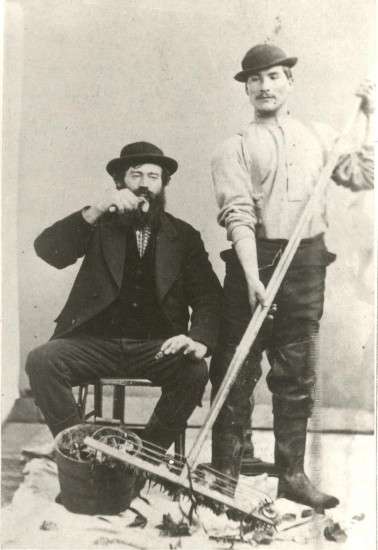
- Abe Wing and James Johnson, circa 1880

I spend a large part of each day looking back in time – at old correspondence, old photographs, old newspaper clippings. Sometimes my search is related to a writing project. Sometimes I’m just trying (again!) to organized bits and pieces that have collected in this old house over the past hundred plus years. For me, looking at the past is a pleasant and often productive occupation.
Sometimes I feel a bit like a detective. When I’m looking at correspondence, for instance, the quality of the stationery, the cancellation stamp on the envelope, the type of handwriting, the formality of the content, all reveal much about the writer as well as their particular relationship to the recipient. The more correspondence from an individual, the more complete a picture I can form of their personality, lifestyle, attitudes and beliefs.
If I happen upon a photograph, especially one that is labeled with date, place, and name(s), I feel fortunate indeed. Visual information is invaluable to someone trying to understand the past. Take the picture of Abe Wing and James Johnson. Though I had seen references to Mr. Wing, it wasn’t until I saw his photograph that I realized he was not Chinese. That had been a quantum leap on my part, based entirely on my only associations with folks named “Wing,” and that inadequate bit of information had led me to assume that there might be at least one Chinese family living in Oysterville in the nineteenth century. Wrong!
Subsequently, I learned that Mrs. Gilbert Stevens’ maiden name was Elvira Wing and that Abe was her nephew. Elvira was the first white woman in Oysterville and her brother Hiram Wing, Abram and Levi Wing (sons of another brother), her sister Harriet, and even her mother, Nancy Grover Wing (Mrs. Abraham Wing) all lived in Oysterville, having come west from Maine to be near Elvira. If there were Chinese folks living in Oysterville, they probably were not named Wing.
My interest in James Johnson, the other man in the photograph, is more personal. I know a number of descendants of “Captain Jimmy” who lived in a house just south of the church from 1870 to 1889. He was drowned in a tragic accident on the bay shortly before the birth of his eighth child, Myrtle. Members of the Johnson family still hold periodic reunions here in Oysterville and our families have maintained friendly ties over four generations. It is nice to put a face to a man I have heard much about.
And, of course, besides providing a look at Abe and Captain Jimmy, the photograph shows something about the early oyster industry here – a bucket, a pair of oyster tongs (which my friend Tucker pointed out were tongs used for Native oysters and were different from the tongs in use in later years for the Pacifics) and a raw oyster, apparently being eaten with the assistance of an oyster knife. This is the historic photograph that I hoped to use as the cover for my Oysterville book. Unfortunately, the requirement of the publisher was for a photograph with a horizontal rather than a vertical format. I console myself that it looks terrific as a full-page image on page 21!
Such a formal looking picture. Maybe from a professional? Wonderful, if it is, that they added the paraphernalia of Oysterville to the set.
Yes, I’m sure it was done by a professional. It is my understanding that “itinerant photographers” went from town to town in those days taking pictures, so it is entirely possible that it was taken more-or-less on site with all of the paraphernalia near at hand.