Gfts from the Girls
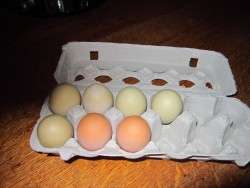
It may be my imagination, but I think the eggs of our Ameracaunas are a lighter blue than they used to be. For that matter, I think the Wyandottes’ eggs are more pink than the brown color they promised us. Not that it matters as far as the contents go. The eggs of all four girls are perfect from their perky stand-up yellow yolks to their clear non-runny (there must be a name for that) whites. And they taste delicious.
Granted, our girls are two-and-a-half years old now. That’s not quite middle-aged in the backyard chicken world, but perhaps old enough that their egg colors are beginning to fade. They should continue to lay, though less often, until they are five or six or even seven years old. I read recently about a buff orpington who is still giving her owners eggs (though spasmodically) in her seventeenth year!

Early Morning Treat
In the commercial egg-laying world, hens are slaughtered when they reach a year or two in age. If they are no longer producing at an optimum rate – presumably an egg a day – they are no longer financially viable. It’s probably lucky for our girls that we have never figured out what their eggs cost – in terms of their food and general upkeep. For us, that’s really not the point.
We love the eggs, of course. But we also like having the chickens free-ranging in our yard. It’s like having moveable yard art. We don’t consider our girls pets, exactly; ordinarily, we don’t name them. We do feel protective of them and we always have an eye out for their welfare. But they are in a category of their own.
So, we don’t really care if their blue genes (or brown genes, for that matter) are wearing thin. I don’t think we’ll care too much when they stop laying all together, though I imagine we’ll add some younger members to the flock as production noticeably decreases. Meanwhile, a dozen-plus eggs a week, no matter what the color, suits us just fine.
nonrunny => gelatinous (?)
I thought about that, John, and then I thought it sounded to icky for our lovely eggs… lol