
Aaron Webster (from his FB site)
You may know Aaron Webster, Interpretive Specialist at Cape Disappointment State Park. I thought I did, too – not well, mind you, but in a member-of-the-community sort of way. I’ve heard talks he’s given on the art of power point presentations. I’ve seen him leading tour groups up at the Cape D. Lighthouse. I’ve even spent an evening with him (and a gaggle of others) at the Sea Hag Tavern in Ilwaco when we celebrated his television debut as Joe Knowles in the Travel Channel series “Mysteries at the Museum” a few years ago.
But yesterday at the Community Historian class, I had a glimpse into ‘the real’ Aaron Webster – the man of Swedish heritage whose boyhood dream was to grow up to become an Indian! As unfeasible as such a desire seems, Aaron has come mighty close. His training as a geologist and his interest in archaeology and his passion about the technology of the earliest inhabitants of this area – the ancestors of the Chinooks – have coalesced into his expertise as a flintknapper – maker of spear points and arrowheads from chunks of flint (also called chert or obsidian).
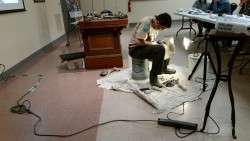
Aaron Webster at Work Yesterday
As we watched, Aaron demonstrated the art of knapping. With bone tools that he had made replicating the materials and methods of a thousand-plus years ago, he hammered and chipped at a piece of shiny, lethally sharp, obsidian – all the while talking to us about the process of ‘lithic reduction’ which is the fancy name for chipping off flakes from a stone core. He talked about the process being far from random and the ‘stories’ that an ancient spearhead or arrowhead can tell, right down to who might have made it.
When he was finished, he had a lovely looking spearhead (as well as a pile of flakes that can be used to make smaller arrowheads or knives). He apologized for not having time to sharpen the spearhead properly – an endeavor that involves removing tiny flakes of obsidian all around the edge of the weapon. He presented the not-quite-finished piece to Museum director Betsy Millard who says it will adorn her desk in a place of honor.
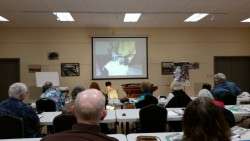
Aaron Live and Projected at Community Historian Class
During the morning, Aaron also showed us some of the other items he has crafted in the old way – a Chinookan style bow, a spear shaft, and an atlatl (also fashioned after ancient ones found in the Tillamook area not far from here. He talked about the traditional materials, still available in our area, processes of making paint and bending wood and gave mini-demonstrations (as in not actually letting a projectile fly) of a tried-and-true technology from ancient times.
It was one of the best ever Community Historian classes! It gave me a whole new appreciation for all the little boys I’ve known who played Cowboys and Indians and wanted to grow up to be one or the other. Do kids still do that? Or is it now politically incorrect? I surely hope not.
I really liked the article and would love to meet him and ask questions, but flint, chert and obsidian are far from being the same thing.
I probably mis-stated what I understood him to say, Bruce, but here are a couple of exerpts from the internet that probably explain it better than I did: “For the sake of simplicity, we have lumped the preferred materials for making stone tools into two broad categories; flint-like and obsidian. The flint-like materials (such as chert) are mainly made from Silicon dioxide (SiO2) which is also known as silica.” And from another source: “Minerals are the natural crystalline materials that form the Earth and make up most of its rocks. The most important group of minerals involved in the formation of flints/cherts is the Silica Group. This large group includes all minerals with the primary chemical formula 5i02 (silicon dioxide) and is most abundantly represented in nature by pure quartz and its many cryptocrystalline forms…”