The Word According To…
Several people have asked me lately what the advantages are to having a publisher rather than self-publishing. Although I’ve had quite a bit of experience in both arenas, I don’t pretend to be an expert. I think my friends Maggie Stuckey and Birdie Etchison could probably talk more knowledgeably about this question. For me, though, the answer comes down to three things: production, marketing, and distribution.
If you 1) have the capital to invest in producing the sort of book you envision as a finished product and 2) if you have the ability to get the word out to all that book’s potential buyers and 3) if you can then handle their orders and get the book to them… then self-publishing is the way to go. By self-publishing, you have the last word on every aspect of your book which, in some ways, is fabulous – especially if you are a bit of a control-freak like I tend to be.

Warehousing Woes of the Self-Published
On the other hand, having a publisher gives you an entire crew of helpers – the eyes of copy-readers and organizing skills of editors, the creativity of the layout and artistic staff, the expertise of the production crew, and the ability of the marketing and distribution people to get the book into the proper venues and, ultimately, into the hands of readers. Once you’ve finished the writing part, you are D-O-N-E!
Authors often sing the praises of their editors. A good editor is worth their weight in words, as they say. But it is the entire publisher package that relieves the author of most responsibilities beyond the writing. For me, at this point in my life, that’s a huge consideration.
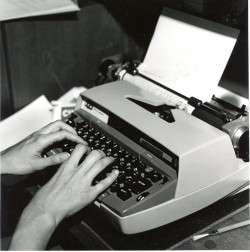
Sydney-at- Work, 1968
All of which brings me to the latest news from History Press, publisher of my current book. They have finalized the title: Jailhouse Stories from Early Pacific County: Tales from the Jumping-Off Place. It’s actually a combination of the two possibilities I suggested in my original proposal: “Jailhouse Stories from Early Pacific County” or “Jailhouse Stories from the Jumping-off Place.”
I thought that my second suggestion was more provocative but the History Press policy is that “the title should prominently feature the name of the geographic area covered in the book.” I am pleased that they combined the two and am more than a tad curious as to how the cover designer will manage all those words. Meanwhile… I have words of my own to manage. My final deadline has been moved up a month to December 12th. YIKES!
Good blog. I hope to one day sit down and work on my dad’s memoires. I have a friend who self-published her father’s, but I’d really like to find a publisher still interested in the Greatest Generation.
Well, I might have agreed with you centuries ago, but not today. Even the big boys don’t do promotion for their writers unless you’re Don Brown or J. K. Rowling. Marketing, today is the writer’s responsibility. Anyone can publish a book, but selling it is another matter. Plus whatever you sell. you split with the publisher who mainly just prints your book then, expects you buy it from them at half price and sell it on your own. Small presses are unreliable. They go out of business, the small press owner(s) get sick, divorced, you name it. A few are dishonest. I’ve had 3 publishers. My next novel I’ll publish with Amazon on “Create a Space.” They do the publication and help you with a cover and keep accounts of your sales. They take a fair amount for this but on the other hand, you eliminate the middle man: the small publisher. Think the cachet of being with a publisher is dying. Writers are figuring out there’s no need for the middle man. Being a writer is now an enterprise and he or she has to take charge.
When I had a publisher, “my share” was 10% of the cover price. When I self-publish, there is the POTENTIAL to make much more, but with the “industry standard” of handing over a whopping 40% to the bookstores, I find I must get myself out there and do holiday bazaars, Meet the Author events, book signings and so forth… Unfortunately, it all washes out about the same EXCEPT I get to have, as your title says, the last word in what goes in and how it all comes together.