- Our Place

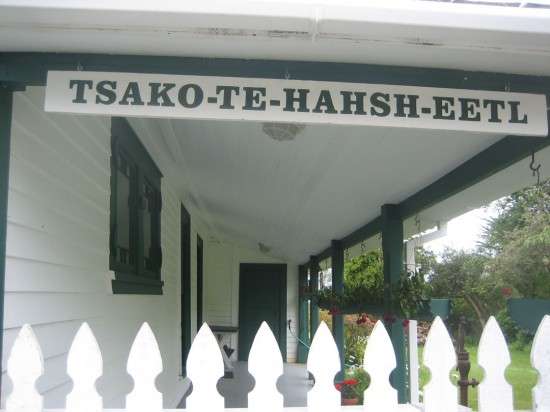
The sign on the porch above our gate has been there as long as I can remember. It says “TSAKO-TE-HASH-EETL” and means “place of the red-topped grass.” It is what the Chinook Indians called this area because in the summer, beginning about now, the seed heads on the native grasses turn red.
I’ve never thought of tsako-te-hash-eetl as a house name, although I’ve heard visitors refer to the house that way. As I understand it, they are the words Old Klickeas used to describe this northeastern shore of the peninsula to my great-grandfather, R.H. Espy, in the fall of 1853. It’s a place name, not a house name.
Tourists often want to know how to pronounce it (pretty much like it looks) and ask, “exactly what language is it, anyway? Japanese? Finnish?”
“Chinook Jargon,” I tell them. At least, I’ve always thought that because I’ve been told Espy was fluent in the Jargon; I’ve never heard that he knew the actual Chinook language. Of course, the Jargon was a spoken, not a written language, so the words on our sign must be an approximation only. One of my friends who was trying to learn the Jargon told me he didn’t believe I was right about those words; he couldn’t find anything similar in Edward Harper Thomas’s Chinook: A History and Dictionary.
Another friend working toward her PhD in biology at the University of Washington picked samples of all the red-topped grasses in our meadow in front of the house. She identified three different kinds but said none of them were “native.” She said they are all “introduced” species. Hmmm. Foiled again!
Nevertheless, I’m sticking to the explanation that my mother, my aunt, and my uncles always gave about the sign and its meaning. Throughout my lifetime it has defined this place in a very special way. And that’s good enough for me.
Skookum!
Chinook pidgin is fascinating. As the trade language spoken within much of what was known as the Oregon Territory my guess is that R.H. Espy and many other must have known it well. Searching it on wikipedia http://en.wikipedia.org/wiki/Chinook_Jargon tells more about the language. It was an easy to learn language with a vocabulary of only a couple of hundred words, and was apparently was a language accepting many regional variants. A word I learned growing up was muka ti muk which apparently a version of mukamuk meaning a high a**ed person (not an entirely complimentary term!)
Thanks for reminding me.