Mrs. Stevens’ ABCs
In retrospect, these books might be my biggest “mistake” – but only from the standpoint of marketing, The ABCs stand for basics – as in essential information. Never mind that they are written in an A-B-C format (cleverly, I thought!) These are NOT children’s books! But thus far, I cannot convince booksellers or grandmothers… and so they are displayed in the children’s section with predictable results. For each of the books below, I am including a short excerpt – perhaps of interest to children as well as to adults, but concepts and vocabulary – not so much. They are perfect for a down’n’dirty look at the facts about this interesting sandspit – a must-have coffee table book for visitors to browse as they explore our area.
Unless otherwise noted, all books are available at local booksellers or directly from me and sell for $10 each.
In retrospect, these books might be my biggest “mistake” – but only from the standpoint of marketing, The ABCs stand for basics – as in essential information. Never mind that they are written in an A-B-C format (cleverly, I thought!) These are NOT children’s books! But thus far, I cannot convince booksellers or grandmothers… and so they are displayed in the children’s section with predictable results. For each of the books below, I am including a short excerpt – perhaps of interest to children as well as to adults, but concepts and vocabulary – not so much. They are perfect for a down’n’dirty look at the facts about this interesting sandspit – a must-have coffee table book for visitors to browse as they explore our area.
Unless otherwise noted, all books are available at local booksellers or directly from me and sell for $10 each.
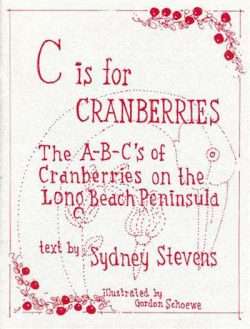
C is for Cranberries
The A-B-Cs of Cranberries on the Long Beach Peninsula – illustrated by Gordon Schoewe
L is for laws – Two pieces of legislation have been written specifically for cranberries…
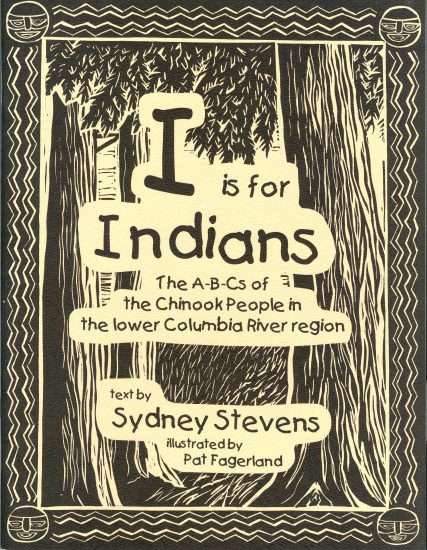
I is for Indians
The A-B-Cs of the Chinook People in the lower Columbia region – illustrated by Pat Fagerland
G is for gathering – Their luxuriant coastal environment provided a wealth of foodstuffs, medicinal plants, and a rich variety of materials for making the tools, utensils, and equipment the Chinooks needed.

D is for Discovery
The A-B-Cs of the Lewis & Clark Expedition’s Winter on the Pacific Coast 1805-1806 – illustrated by Pat Fagerland
Z is for zoology – Lewis considered himself a better zoologist than botanist. During his stay at Fort Clatsop, he wrote about thirty-five mammals, fifty birds, ten reptiles and fish, and five invertebrates, many of which were new to science.

P is for Papa Train
The A-B-Cs of the Long Beach Peninsula’s Narrow Gauge Railroad 1889-1930 – illustrated by Scott Fagerland
A is for abandonment – The little train that had traveled the length of the North Beach (now called Long Beach) Peninsula for more than forty years, made its last run on September 9, 1930.
P is for Peninsula
The A-B-Cs of the Long Beach Peninsula and Vicinity – illustrated by Noel Thomas
Y is for year ‘round – Tourism, once a summertime-only phenomenon, is now a major factor in the economy of the peninsula.
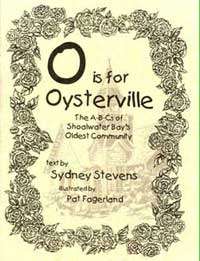
O is for Oysterville
The A-B-Cs of Shoalwater Bay’s Oldest Community – illustrated by Pat Fagerland
N is for National Historic District – On July 4, 1976, Oysterville was placed on the National Register of Historic Places by the National Parks Service.
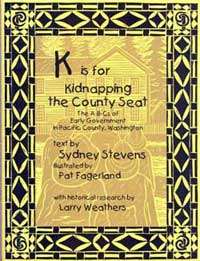
K is for Kidnapping the County Seat
The A-B-Cs of Early Government in Pacific County, Washington – illustrated by Pat Fagerland and with historical research by Larry Weathers
B is for before – Long before there was a Washington State – indeed, even before there was a Washington Territory – there was Pacific County.
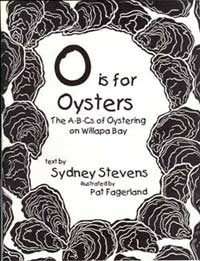
O is for Oysters
The A-B-Cs of Oystering on Willapa Bay – illustrated by Pat Fagerland
W is for Willapa Bay said to be the largest unpolluted estuary left in the continental United States…
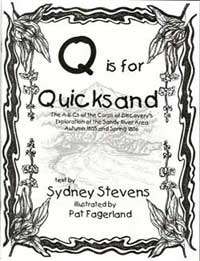
Q is for Quicksand
The A-B-Cs of the Corps of Discovery’s Exploration of the Sandy River Area – Autumn 1805 and Spring 1806 – illustrated by Pat Fagerland
Z is for zenith – Though the hoped-for Northwest Passage had not materialized, discoveries made during the Lewis and Clark Expedition did, indeed, unlock the treasures of the continent and, eventually, led to the fulfillment of Jefferson’s dream.
*Q is for Quicksand available only through the Troutdale Historical Society. Inquiries should be directed to Troutdale Historical Society, 104 D.E. Kibling, Troutdale, OR 97060.