
The Greenman House, 1984
“There is no way to legislate morality.” That was a popular lament during the sixties when we were trying to raise the collective consciousness about racial discrimination in this country – a lament and a truism that doesn’t go away. I thought about that yesterday at the Oysterville Design Review Meeting, not in terms of how we treat one another, but with regard to how we perceive the entire concept of preservation of historic structures, particularly here in our little village.
There was mention, though not a full-fledged discussion, about building demolition and the process property owners need to follow when a building needs to be destroyed or taken down. We’ve had a number of these situations in Oysterville since we became a National Historic District and, yet, the proper way to proceed continues to be a red flag discussion item.
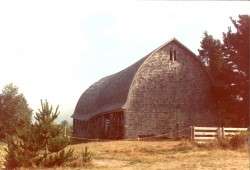
The Bard Heim Barn, circa early 1980s
Among the old buildings here in Oysterville that have “disappeared” over the last forty years are the Greenman House at the corner of Oysterville and Territory Roads, the Bard Heim Barn just off Clark Street, the “Teacher’s Cottage” on Territory Road, the “Annex” at the John Crellin House, also on Territory Road, and the Captain Stream House on Main Street — not to mention the old “Meat Market” and the original Freshley House, both lost to fire. As my mom would have said, “That’s quite a-many.”
Although I have been here during the demise of all those buildings, I am unclear which of the property owners actually went through the Oysterville Design Review process, which went directly to the county’s Department of Community Development, or which went to the State Office of Preservation and Archaeology for advice. Nor am I clear in all of the instances whether the buildings (other than those that burned) were purposely taken down or allowed to collapse without comment – a situation that seems to fall under the category “benign neglect.”
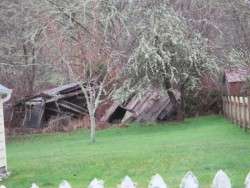
On Territory Road
Of course, right now the central focus is the Captain Stream House. For one thing, it is the only such situation some of our newer residents are familiar with; for another, its demolition and replication are a shining example of what could have happened in all the other instances. Amazingly, there are community members who feel that the process should have been done differently and who seem to be trying to move heaven and earth to make the owners the bad guys rather than give them an award for their exemplary efforts.
After the meeting yesterday, Nyel and I traversed the town to see what might be the next controversial demolition project. As far as we could see, there is only one possibility – a barn behind the house of one of the most outspoken critics regarding this topic. Go figure…
Love the love of Oysterville you show. I’m confused, “Make the owners the bad guys?” What is the logic here? bad because the property is in disrepair, or bad because they aren’t going through the steps to remove it, or bad because they are not starting to repair? Or what?
Good questions, all! Many of us in Oysterville are similarly confused.
Hello Sydney….I’ve often wondered about the barn behind the yellow house on territory road, and while it, as the last barn in Oysterville, was allowed to collapse. As per usual, thinking about this barn, and why it was also allowed to collapse, also makes me think about the Bardheim barn, and why it was allowed to collapse, especially since the person who owned it at the time, had a huge amount of resources to save and or rebuild it! Thinking about all Barns in Oysterville past, present, and future, and, thinking about the Design Review Guidelines makes one realize that constructing something like the Bardheim barn would be impossible under today’s guidelines, which restrict facade length and height. While I’m all for reducing the mass and scale of most buildings in Oysterville, I would love to see another large barn within the National Historic District. In a rural community like Oysterville, barns would typically have been the largest, simplest structures. Built completely for function, and for ease of construction. I understand why restrictions on facade length and mass and height and scale were written into the design review guidelines. I would love to know when the guidelines were written if this was discussed, and if anyone realized that they were making it impossible for someone to build a large rural structure which would be perfectly appropriate in Oysterville.
I also have another comment. The next structure that I would worry about being neglected to death is the Heckes house. Afterer the current owners are through neglecting it, it will be in worse condition than the Captain Stream house, which as you have pointed out, has been demolished, yet painstakingly recreated. We can only hope that the next owners of the Heckes house have as much money and sensitivity as Martha Klmer and Stephen Romero (current owners of the Captain Stream house). it would seem very unlikely to me.
Remembering when ORF was formed, one purpose was to get grants for preservation of historic dwellings. ORF needs to step up to assist in the preservation of the Heckes house.
I couldn’t agree more! However, back in 1976 when Oysterville was granted National Historic status, there was funding available through the Department of the Interior and property owners could apply for matching funds. That’s how the church was restored and, that’s how Helen Heckes was able to restore the balcony at the John Crellin house. Ironically, those funds “dried up” shortly after that and there is no comparable funding source now available. It is an ongoing concern for many of us in the village, as you know.
Hi Sydney,
I’m checking in to see what’s up in the village, and I am sad to see that the barn behind the yellow house has fallen. I loved that old building. I’d go snoop there when the property was vacant years ago, and it was fascinating. Two story on the north end, with gillnets (and wooden floats!) in the attic, a 2-horse (?) stall in the east end of the south side, and a wonderful workbench on the south end; it ran the length of the building (east to west) and was immediately beneath a full bank of windows. [Before the electric lights came to Oysterville?] I admired the form of the building and its usefulness. The iron woodstove made me think it must have been a fine retreat.
I agree with Bradley. To lose the John Crellin House would be criminal. My Mother might have said, “Fish, or cut bait!” Take care of it or sell it.
Thanks for your blog.