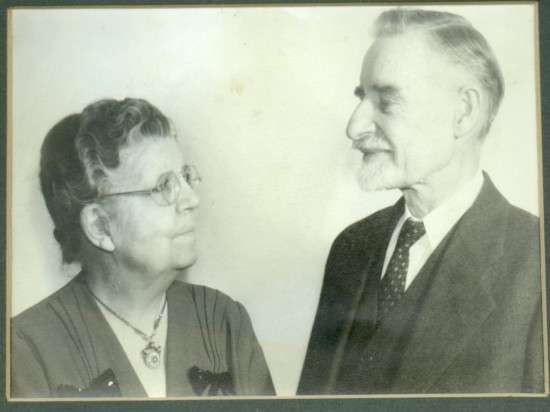
Helen and Harry Espy, 1947
In 1949, my Oysterville grandmother, Helen Richardson Espy, was 71 years old. A combination of glaucoma and cataracts had rendered her legally blind – she could see light and dark but could not readily make out faces. Still, she managed to take care of this big house and look after my grandfather who, at 73, was beginning to exhibit some dementia.
Despite all, she managed to write weekly to each of her four surviving children. Her letters were full of family and village news, commentary on the current political situation – world and national – reviews of books she had ‘read,’ and the usual sorts of encouragement and sympathy that an interested, far-away mother would write.
Her correspondence was typewritten. She had taught herself to type by touch when she realized that she was losing her sight. She also availed herself of “talking books” from the Library of Congress and listened daily to several news programs on the radio. Neighbors, friends, and relatives dropped by frequently to visit. All-in-all, she was well informed and articulate and her letters are a treasure-trove.
This week I’ve been reading her letters to Willard written in 1949. Even though I was thirteen that year and spent a good deal of time with my beloved Granny during the summer, the letters are full of detail that I have long since forgotten. For instance, it was that year that the ‘road behind the schoolhouse’ was completed. The old “Nelson’s Corner” at the south entrance to Oysterville is still so vivid in my mind that I have thought the extension of Sandridge west of the village hadn’t happened until the 1960s. Wrong!
I also didn’t realize that the downstairs bedroom in our house – the erstwhile parlor of my mother’s childhood – had been a storeroom for a number of years. It wasn’t until 1949 that it was cleaned out and its contents moved to a secure area built especially for the purpose in the barn across the street, and the room transformed into a bedroom.
The furniture – a walnut bed with matching chest of drawers and wash stand (both with brown marble tops) – was purchased for $35 from friends of a friend in Ocean Park. My grandmother commented that she didn’t like furniture with marble – “too graveyardish” – but that her sister-in-law said it was a beautiful set “and Ruth has good taste.” It was that remark that drove home the fact that my grandmother had never really seen this bedroom set that we still use to this day.
She also wrote about the Holways’ new house next door – “the finest and most expensive on the peninsula” and she mentioned that some more of Millie Sherwood’s relatives had moved here “making 31 of that family now living at the north end of the peninsula.” A few letters later she wrote that Sherwood’s cannery and the house next door had burned to the ground. “We thought for awhile that the entire north quarter of the town would go up, but the Ocean Park firemen were wonderful.”
With each letter the details of life here in Oysterville during that time become clearer. Reading about events as they unfolded and her commentary about contemporary concerns – how adamant she and my grandfather were. for instance, against the dredging out on the oyster grounds! – puts village life into a context that no historian could ever capture. Bless her for her writing and bless the family for what she called their “packrat tendencies!”
You are truly blessed to have those letters. Thank you for telling us about their contents. We so often forget where we come from. The fact that you have these treasures from the past makes it possible to keep the connection intact. God bless you.