- On The Cutting Edge
Oysterville was not on the grid, electricity-wise, until 1938 – seventeen long, dark years after the rest of the peninsula had power. By November 1921, the privately owned Ilwaco Light & Power Company had a 100 KW power steam generating plant up and running “Full 24 Hours Service.” But it was not dependable and it was not available to everyone.
In 1937 voters decided to give public ownership a try and approved the formation of Public Utility District No. 2 of Pacific County. That made the various private companies nervous and it was not long before West Coast Power Co., which supplied electricity to the peninsula, – but not to Oysterville – lowered their rates, and ran a power line north.
In the April 29, 1938 issue of the Chinook Observer, Oysterville correspondent Edith Olson wrote:
Electricity has come at last to Oysterville, the oldest town in the county, rich in historic interest. This is truly a case where the first shall be last. For several years past…hope has risen to dizzy heights and dropped to black despair times without number, while we have waited neglected, almost forgotten except when the cries of our woes became too loud to be ignored. But at last our dream is realized…
As a matter of fact, Oysterville did have some access to electricity before the thirties. My mother remembered that in the early 1920s Bert Andrews (who everyone agreed was a ‘mechanical genius’) had rigged a generator that could supply electricity to some of the households in town. “It was about enough for one electric light,” Mom remembered, “and it was turned off at 10:00 p.m. when Bert and Minnie went to bed.”
Even so, my grandfather must have been hopeful that better service would be available. Among some of the old pamphlets recently uncovered I found “The Farmer’s Electrical Handbook” for which he paid a whopping fifty cents in 1917. Published by the Western Electric Company, it contained “such electrical information and practical working directions as every farmer and country resident will find useful.”
My grandfather was a dairy farmer and he, no doubt, was interested in all of the labor-saving devices that the handbook described – motor driven cream separators and electric milking machines and electric hay cutters. As far as I know, though, none of those tantalizing, cutting-edge items ever saw service on Papa’s farm. It was a by-hand operation until he retired in 1930.
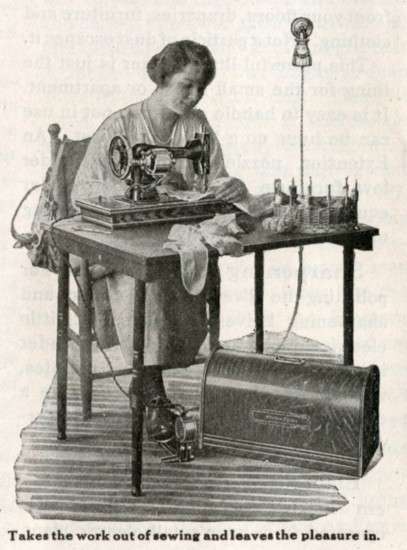
My grandmother, also, must have poured over the booklet. “Electric Cooking,” “Electric Washing,” and “Electric Cleaning” were described and pictured. I was interested that, although electrical outlets and their installation were described, they weren’t shown in the pictures. In each illustration of household appliances – vacuum cleaners, sewing machines, toasters, tea kettles, irons – the electrical cord was neatly screwed into a nearby light socket. It looked to be a short tether in some cases.
In the 1940s, my grandmother was still using a hand-operated carpet sweeper and a treadle sewing machine. She still had a wood cook stove and an old stovetop percolator. The only electrical “gadget” I remember was a two-sided toaster. When the power went out, as it did fairly regularly in winter, life went on just as usual. So much for being on the cutting edge in Oysterville…
0 Comments