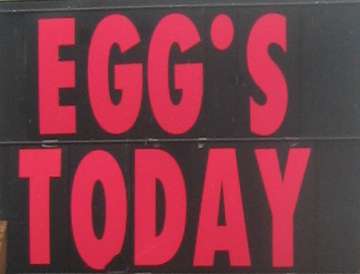
A well-traveled friend recently remarked to me, “Americans just don’t get apostrophes!’ I was relieved to hear that. I thought it was just the local Americans who don’t get them. But, apparently, it’s a problem on a national scale.
As a primary teacher, I taught punctuation to first, second, and third graders. First graders can master periods and question marks. Second graders can master quotation marks and even some commas. Third graders can master apostrophes. Honest!
There are three main rules:
Rule #1. Do not use an apostrophe if you want to make a word plural. Not ever.
Rule #2. Do use an apostrophe when you write a contraction.
Rule #3. Do use an apostrophe when you want to show possession.
Okay. First, the first rule. If you want to talk about more than one thing, add an ‘s.’ Not an apostrophe. As in, one egg. Two eggs. Sometimes you need to add es. As in one potato. Two potatoes. And sometimes you do nothing at all. As in one deer. Two deer. But never ever do you add an apostrophe when you mean more than one.
Now for rule number two. When you use a contraction – that is when you shorten a long word or combine two words to make a short cut, use an apostrophe for the letters you leave out. As in can’t for cannot. Or isn’t for is not. Or won’t for will not because willn’t sounds silly.
And then there’s rule three which is the hardest one of all. When you want to show that something belongs to someone, tie it to them with an apostrophe ‘s.’ The boat belongs to John. Therefore, it’s John’s boat. The house belongs to Mr. Brown. Therefore it is Brown’s house. But what if it belongs to all of Mr. Brown’s family? If it belongs to all the Browns, then it is the Browns’ house. You could say the Browns’s house but it sounds awkward and, besides, it’s not necessary or even correct.
So, when I see a sign that says “The Smith’s” I feel a bit confused. There must be just one Smith living there. And when I see a sign that says “egg’s for sale” I wonder. Does that mean just one egg is for sale? Because that is what it says. Or maybe it means that something belonging to egg is for sale – egg’s (shell) for sale. Surely, if it means more than one egg, there wouldn’t be an apostrophe.
As I say, apostrophes are easy. On the other hand, commas are hard. They are definitely not my friends…
What a great description of how to use an apostrophe!! If you could do the same for the different uses of “me” and “I” that would be great. Those two words are so misused lately, it drives me CRAZY!!
My pet peeve is when seen is incorrectly used, as in, I seen him go into the store. It drives me nuts and I have trouble not correcting the offender. What can I say?