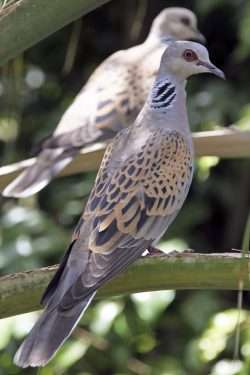
Two Turtle Doves (European Turtle Doves)
Yesterday, the second day of Christmas, was “Boxing Day” — traditionally a day to give alms to the poor but, more recently, a day to not shop. I wonder how the one segued into the other. I’m sure it has to do with the affluence of some and a twisted idea that by not shopping they are doing something beneficial. For me, it’s easier to think of it as the Day of Two Turtledoves though I’ve never seen one in person.
Today, of course, is the day I’m expecting my true love (that would be Nyel) to present me with Three French Hens. It is my understanding that when the Twelve Days rhyme was written in the 18th century, French hens were a prized table bird in both France and England. The breed Bresse Gauloise, for example, was sometimes called “the queen of poultry” or “the poultry of kings.” But, I hasten to add, if Farmer Nyel were to remember me with such a gift, those hens would undoubtedly be on the hoof (so to speak) rather than roaster-ready.
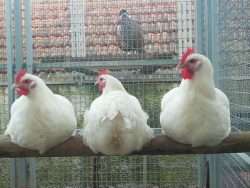
Three French Hens (Bresse Gauloise)
Those French Hens would actually be a welcome addition to our flock. Right now we are down to only three girls — Slutvana, the Russian Orloff; Little Red Hen, from Rhode Island, USA; and Clara, our black and white speckled hen whose ancestors could have come from Columbia. Three Bresse Gaulouise, for instance, would improve the international flavor (ahem!) of the coop.
French Hens are not only famous in song, but popular in artwork as well. My favorite painting is by Will Bullas — the three girls in berets, French style stripes,and with cigarettes (perhaps the infamous Gauloises brand?) dangling from their beaks. But, I’m not in the market for artwork. No, I’m holding out for the really-o, truly-o, in-the-flesh fowl — even if it takes until springtime when the peeps start showing up in the feed stores.
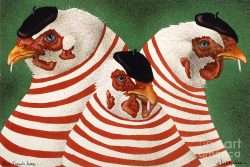
“Three French Hens” by Will Bullas
Tomorrow might be easier. Just a partridge in a pear tree — and we already have a fine old pear tree out in the southeast garden. I don’t think partridges are prevalent hereabouts, although we used to have quite a population of grouse (who are sometimes confused with partridges). But I don’t really have high hopes.
0 Comments