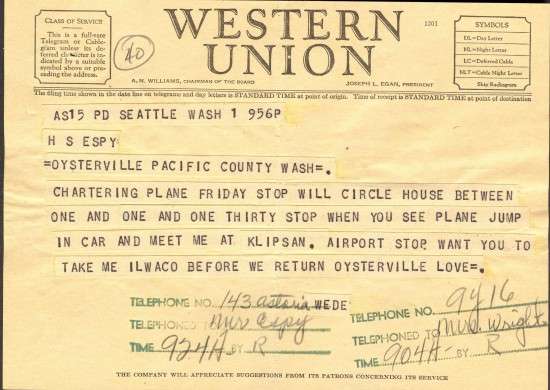
- 1947 Telegram
Once upon a time – even in my lifetime – there was romance to flying. Before nine/eleven and mega security checks and two hour waits in over-crowded airports, getting somewhere by airplane was efficient and made good sense. Especially for folks trying to get to remote points like Oysterville.
Many are the stories about U.S. Supreme Court Justice William O. Douglas who had a cabin nearby. He would land his airplane on the beach and at some time during his stay he would have Oysterville garage owner, Bert Andrews, look it over and make sure it was ready for take-off back to Eastern Washington.
Douglas often sat side-by-side with Bert in the big rocking chairs on the Andrews’ front porch passing the time of day. Bert was my grandfather’s age and everyone considered him a mechanical genius. Douglas was a generation younger and served on the Supreme Court for thirty-six years. I often wondered what they had in common and found to talk about during those visits.
By the time Bert was checking out William O.’s plane, it was already illegal to land on the beach. Even though the hard flat sands made the perfect landing strip, the beach had been outlawed to planes as far back as the 1930s when Marian Williams was killed. According to Virginia Williams Jones, “She thought the plane was going to hit her sister’s baby or hers, so she ran to grab up the baby and ran right into the propeller and was killed. As a result, airplanes on the beach were outlawed.”
Not too many years later, during World War Two, a landing strip was put in on a grassy meadow at Klipsan Beach. After the war, it was used now and then by civilians. I miss the windsock flying near the shed-like building we called the “Klipsan Airport.”
Recently I ran across a telegram sent to my grandfather in Oysterville from my Uncle Willard. He was flying from New York to Seattle and then chartering a plane to Klipsan Beach. The message from Western Union read in part: WILL CIRCLE HOUSE BETWEEN ONE AND ONE THIRTY STOP WHEN YOU SEE PLANE JUMP IN CAR AND MEET ME AT KLIPSAN STOP…
Those were the days, all right!
The fact that that treasured and antique instrument–the telegram–was preserved, shows how impressive and quirky the occasion was. It’s so Willard, and that era. I can just see him exiting the plane, perfectly folded silk handkerchief peeking out of his jacket pocket, a rosebud in the lapel button–relishing his role as the returning conquering hero. And all at Klipsan!
Justice Douglas had a place at Goose Prairie where the Boy Scouts of the Yakima Valley also had their summer camp. I remember one summer at scout camp (about 1963) hearing a rumor, which was passing around camp among the boys, that Justice Douglas was at his place that week with his latest young wife. There were claims that some of the boys had actually seen them. Was this the Eastern Washington place where Justice Douglas was flying from to North Beach Peninsula?
I’m not sure about that. I only know that he had “a place” in Eastern Washington and I think that he eventually retired there.
A thought-provoking post, as usual, Sydney–the part about the telegram in particular. Just happens that yesterday, my 3rd graders were reading a biography of Thomas Edison, and the subject of telegraphy was raised. They had lots of questions about telegrams, Morse Code, and the like, but my knowledge of the subject is thin. After reading your post, I got to wondering why they used “STOP” for the ending punctuation. Why not just put a period there? (A question mark was QUERY, by the way.) I googled the question, looked at several possible answers on various web site, and finally came upon what seems to be the jackpot. For those interested, see http://www.telegraph-office.com/pages/telegram.html, where you’ll find a treasure trove of fun information about telegrams. Are telegrams really so different from text-messages? Not in terms of the importance of the economy of words. I don’t think Morse included LOL or OMG but it had a few tricks of its own.
Did you notice that the telegram actually says “…between one and one and one thirty…”? I’m pretty sure that was an operator error — Willard’s cash was always too tight to afford a mistake of two extra words!
My father always pointed out the airstrip at Kilpsan when I was a child and I was sorry to see it get over grown and in disrepair. You wouldn’t even hardly know it was there. And telegrams…I was telling the students at school that it was a telegram that informed my grandparents that their two oldest boys had survived the attack on Pearl Harbor and Kaneohe Bay. We were watching a National Geographic special about December 7th and one veterans interviewed said that his family did not receive his letter for three weeks after the attack. I guess that sailor didn’t have the money for a telegram. Even at that the rumor got started around my grandparents town that they’d both been killed that day. What a different world we live in today in terms of communication! I agree that texting is similar to telegrams. I still have the telegram my uncle sent to my grandparents.