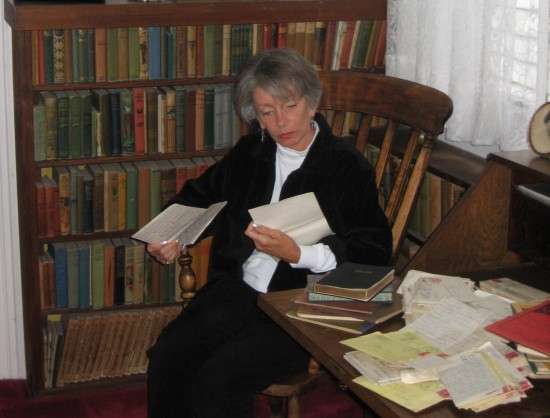
- Medora’s Letters: Treasure Trove from the Past
For many writers (well, those who write prose, either fiction or non – I don’t really know about poets), one of the most time-consuming aspects of their work is research. It can be one of the most pleasurable parts of the writing process, or it can be tedious and difficult. Whatever it is to each writer, it is usually a necessity.
I recently heard an interview with Karen Harper who writes “The Queen Elizabeth I Mystery Series.” (The tenth comes out this month.) She has immersed herself for years in Tudor history (1485-1603), particularly Elizabethan England (1558-1603.) She has lived in Great Britain, has visited the places that were important during those historic years but even so, she spends about six months doing the research for each book in the series. Usually this takes place several years before the actual writing begins. Then, when she is “into” the book, itself, — the writing takes another six months — she often does additional research on details that she hadn’t anticipated in the early stages of planning her story.
Research takes many forms, of course. It can be a simple matter of interviewing someone who has first-hand knowledge of something you are writing about. It might be looking at old records or newspapers on a microfiche reader. Or it can mean hours in a library – perhaps in a specialty library, looking for information in rare or out-of-print books – or, perhaps, research involves looking at primary documents in the archives of a special collection.
For some sorts of writing, to be there in person can be considered doing the research, in a way. Reporters who are on the scene, biographers who visit the places their subject lived or worked are doing research. Since much of what I write is about Oysterville, living here is its own kind of research. Actually experiencing a winter storm, for instance, makes it far easier to write about, even if you are telling about a storm of a hundred years past.
My writer friend Susan recently journeyed from her Alabama home to the Florida State Penitentiary where the man who murdered her sister in the 1980s is serving three consecutive life sentences. It took her more than four months working with state authorities to set up an interview with him. Susan is writing a book about her sister (not just about the murder) and said before her visit, I have no idea how this is going to shape my story but I’ve always known I needed his voice in it.
I cannot even imagine how difficult that piece of research was for Susan. I don’t always like facing up to the R word but, knowing the lengths to which she has gone, I doubt that I’ll ever complain again.
I don’t believe there is any type of writing that doesn’t eventually force the conscientious writer to delve into the subject at a deeper level. I just finished a children’s picture book, something I wrote “for fun” while my more serious writer’s mind was recharging, and found myself digging around for hours to make darn sure I had my “facts” straight. So if there’s anything you need to know about Pacific tree frogs, also known as chorus frogs, just ask! LOL
Initial research is a drop in the bucket, compared to proof-reading, learning/relearning, rewriting as you learn. The self-education process can be tedious and difficult at times, but it’s necessary for writing something that will carry your name!
I can see where researching the murder of a loved one would, on the one hand, be emotionally draining, but on the other might bring a higher level of closure to the event. Admittedly I will write about something that gets my dander up, but the pleasurable things are things for which I have passion. I don’t know how true crime writers do it.
I have tried to write, at least journal, about the tragedies I have experienced, but I can’t stay in those “places” long enough to bring meaningful depth to the events. These days, I write mostly about things I get joy from researching, like my faith and the “Historical Jesus”, behind what we read in the Bible. {:-D