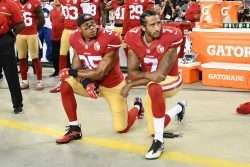
Take A Knee
Everywhere I look these past few weeks – in the news, on social media, in personal emails – there is buzz about ‘take a knee.’ I understand the controversy but wondered about a couple of the basics: 1) where did the ‘take a knee’ expression come from, anyway, and 2) how did the national anthem get all tied up with the beginning of sports events?
The first one was easy. According to the online Urban Dictionary: Take a knee is an American football term for when the quarterback drops to one knee immediately after receiving the snap, thus automatically ending the play. A no-brainer expression for football fans, no doubt, and an easy segue from game to pre-game for football players to make. I might add that this was the first definition for the term listed in the Urban Dictionary but, in the manner of dictionaries everywhere, there are five or six other definitions – several not seemly for a little old lady such as myself to repeat here.
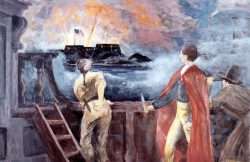
Painting by LTJG James Murray
My second question – not so easy. Every American school child knows (or did in my day) the story of Francis Scott Key penning the words to a poem, “Defence of Fort M’Henry” in 1814 after witnessing the bombardment of Fort McHenry by British ships in Baltimore Harbor. Key was inspired by the large Amerian flag, the star-spangled banner, flying triumphantly above the fort during the American victory. Later, set to the tune of a popular British song by John Stafford Smith, it became known as “The Star-Spangled Banner.”
Not so well known is that “The Star-Spangled Banner” was recognized for official use by the United States Navy in 1889, and by U.S. President Woodrow Wilson in 1916 who ordered that it be played at military and other special occasions. Two years later, it was played during the seventh-inning stretch of Game One of the 1918 World Series, and afterwards during each game of the series. Though some believe that this was the first instance of the anthem being played at a baseball game, there is also evidence (according to Wikipedia) that the “Star Spangled Banner” was performed as early as 1897 at opening day ceremonies in Philadelphia and then more regularly in New York City beginning the following year.
It was not until March 3, 1931 that the song officially became our national anthem by a congressional resolution signed by President Herbert Hoover. By that time, the pre-game anthem ‘tradition’ had spread across all sports. It has been controversial from the beginning – partly because the song is very difficult to sing, but also because of disputes over exactly what the anthem stands for.
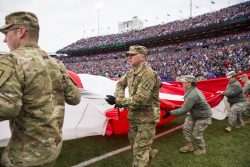
Photo by Brett Carlsen
As early as 1954, some team managers ordered the pre-game anthem stopped but quickly had to relent because of the hue and cry. In the 1960s, an attempt to swap the anthem ‘tradition’ for “God Bless America” met with criticism that our Viet Nam troops were being dishonored. Toward the end of the Civil Rights Movement, the tradition began to rankle some athletes who thought it glossed over racial injustices in U.S. society. And in 2016, there was quite a kerfuffle over the Department of Defense doling out as much as $6.8 million in taxpayer money to professional sports teams to honor the military at games and events. Whether or not that was connected with the singing of the national anthem is unclear. As for the singing part – in 1990, Roseanne Barr made herself infamous by botching the singing of the anthem; ditto Christine Aguilar in 2011.
So, there you have it! In case you wondered…
Sydney: leave it to you to enlighten us on what at first seems taken for granted and on further inspection becomes fascinating…..!
CG