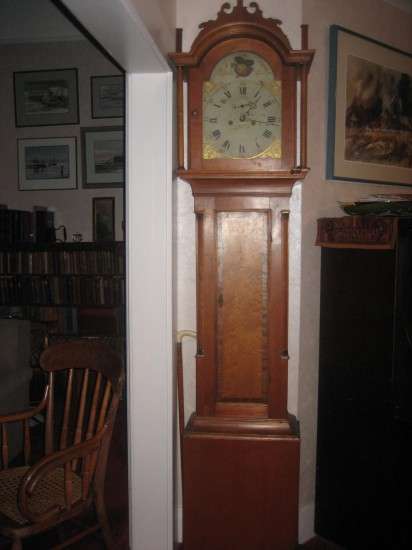
- Bumpa’s Clock

It is said the popular song of the 1950s and ‘60s, “My Grandfather’s Clock” by Henry Clay Work, is what gave the familiar name to the type of clock which should properly be called a longcase clock. They are also known as tall-case clocks or floor clocks.
Ours was, in fact, my Grandfather Little’s, the man I called “Bumpa.” Including the ornamentation on its “hood,” it is eight feet tall, and is a freestanding, weight-driven pendulum clock with the pendulum held inside the tower (or waist) of the case. It is carved of New England fruit woods and the cleaning dates are on the inside of the long door which gives access to the pendulum and weights.
Last week, after my friend Jim Courteier wrote in his “Greetings from Oysterville” blog about all the clocks in his house, I told him a bit about some of ours and wanted to tell him some specifics about the Grandfather’s Clock. When I opened that little door to look at the dates I was appalled to find that they have faded beyond my weak eyes’ ability to read them. Nyel to the rescue!
With a bright light and his much better pair of eyes,Nyel was able to copy down all the information inside the door – information I will type up and attach there for posterity. The very first date says only May 5 / 63 and the next, October 24, 1781, clarifies any uncertainty about which ‘63’ it was. There is only one other cleaning date in the eighteenth century – March 1789. In the nineteenth century there are five dates recorded: 1807 (no month); May 1829; March 1, August 29, 1887 (W.B.); April 2, 1891, Exeter (W.E.B.); and March 1899 (R.). It is interesting to note that clock cleaner W.E.B. came from Exeter which is where my Grandfather Little was born and grew up. I also wonder if W.E.B. was one and the same as 1887’s W.B.
There are also five cleaning dates noted for the twentieth century – March 1906; Feb. 6, 1905; Oct. 1907; Nov. 1911; and Nov. 1915 (W.). Then comes the entries: Property of W.O.B. Little, Nov. 28, 1925; Cleaned by Smith, Sept. 1926; Refinished by W.W. Little (my father who was then a youth of 17) Sept. 1926.
A typewritten note by my father is affixed to the inside back wall, behind the pendulum. It says:
This clock was given to W.O.B. Little in 1925 by a family friend. It had been owned by this family for many generations. It fell to the lot of son Wm (Wm W. Little) to take off the many coats of paint and refinish the original wood. Also, he drew in all the Roman numerals which had long since disappeared.
When W.O.B. Little moved from West Roxbury, the clock was shipped to son Wm who was then living in El Cerrito, Calif., in 1958. In 1972, Wm moved with his wife Dale Espy Little to her childhood home in Oysterville, Wash. The clock came to Oysterville with them.
The clock was whittled out of early fruitwoods in New England probably in the early 1700s. The cleaning dates can be identified back to the late 1700s.
The clock is eventually to go to Wm’s grandson, Charles Morgan Howell, IV.
I wonder who will have the clock and where it will be 300 years hence.
That is a very beautiful clock Sydney! I’m humbled that you would mention me in this post. As for Mr. Charles Morgan Howell, he’s had proper warning to assure ceilings high enough to keep this clock happy.