
The Bridge to Nowhere (Thanks to Frank Lehn?)
The Astoria-Megler Bridge celebrates its half century mark this year and, with that in mind, memories of the transition from ferries to bridge were the topic for yesterday’s Community Historians. Class members were learning to do oral histories. We worked in small groups, interviewing one another and learning about the ‘state-of-the-art’ digital tape recorder which, we were told, can take more than a hundred hours of testimony! I think we could easily have filled its capacity had time allowed.
There were five in our group – two from Oregon (who did not remember the ferries), three from here (who did). Our ‘testimony’ about ferry experiences ran the gamut – from the line-up of cars waiting at Megler (and how you could judge whether you’d need to wait for the next ferry) to the fabulous taste of the chocolate milkshakes at the snack bar.
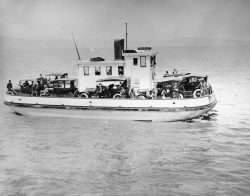
“The Tourist” 1921
We remembered the dire predictions that this side of the river would “lose out” when the “bridge to nowhere” opened and how, in fact, the easier access both to and from here had changed our lives forever. We talked about the bridge toll and remarked that the toll booth has never been removed. Both the Oregon members of our group said they had never really been to the Peninsula “before the bridge.”
But we were all hazy on some of the dates, especially about the first ferries. Even though I’ve written about that very topic, I had forgotten the particulars, so I came home and looked up what I had written. It was back in 2013 (no wonder I couldn’t remember!) in a blog titled… drum roll… “Remembering the Ferry” that I wrote:
It was in the summer 1921 that the first regularly scheduled auto-ferry service began between the slip at the foot of 14th Street in Astoria to the dock on our side of the river at McGowan. At that time, the dock at Megler was still the terminus for the train and the boats that regularly met it from Portland and other points along the river. It wouldn’t be until the trains quit running in 1930 that Megler would become the ferry landing on the Washington side and “going to Megler” became synonymous with “catching the ferry.”

Ferry Sign, 1931 (Charles Fitzpatrick)
That first car ferry, the Tourist, could hold up to fifteen vehicles. The statistics for 1922 show that it carried 6500 vehicles and 25,000 people across the river that summer. That prompted Captain Elving to build a second ferry and in 1924 the Tourist II began service. She had a wood hull, was 98 feet long, 36 feet wide, 8 feet in depth, and could carry 22 cars. Her 200-horsepower diesel engine could propel her along at about twelve miles per hour.
Although other ferries were added to the ‘fleet,’ the Tourist II continued to serve the Astoria-Megler crossing until the beginning of WWII when Elving sold her to the Army for $35,000. She was given a coat of gray paint, became the military ferry and mine planter Octopus and received the “E” pennant for her outstanding service. At the end of the war, Elving bought her back for $36,000.
It’s more likely, of course, that most of us are remembering the M.R. Chessman which went into service in 1947 or the Kitsap which began the run in 1962. Both of those ferries belonged to the State of Oregon to whom Elving sold the ferry business in 1946. And, for those of us who do remember the ferry days, there are dozens of stories…
It was a pleasure to hear just of few of those memories yesterday. I look forward to more when the Columbia Pacific Heritage Museum opens a special 50th Anniversary Astoria/Megler Bridge exhibition on July 29th.
Hi Sydney – The milkshakes were good, but the butterhorns “swimming” in real butter were out of this world. Gayle Pursley Williams and I (Ilwaco H.S. Class of 1960) talk frequently about our fond memories of butterhorns and hot chocolate on ferry trips to Astoria to buy school clothes and shoes at Leon’s.