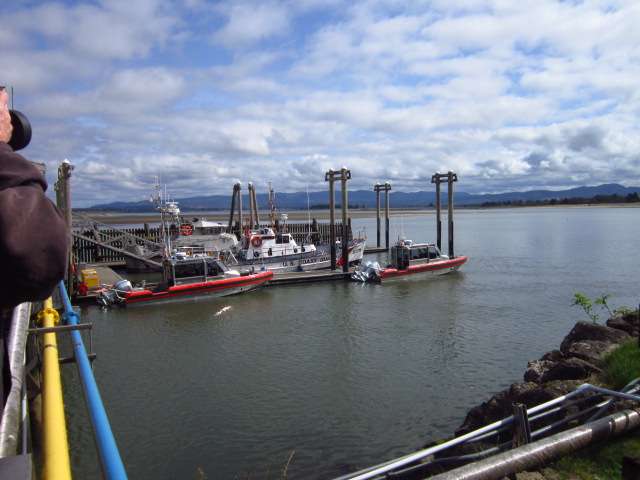
At the National Motor Lifeboat School
Yesterday the ‘Class of 2014 Community Historians’ went on our last field trip of the season. It was ironic, in a way, that it gave us a glimpse at preparation for the future rather than focusing us on what had happened in the past. We were given an up-close-and-personal look at the very latest in technology and equipment at the National Motor Lifeboat School at Cape Disappointment. It was a rare opportunity, especially for a group of ‘old ducks’ who have been focusing on historic archives and ancient artifacts.
Our day had actually begun in the classroom at the Columbia Pacific Heritage Museum with an overview of the U.S. Government’s historic presence in Pacific County. Instructor Donella Lucero spoke about the Forts at the mouth of the river – Canby, Stevens, and Columbia – and of the lighthouses, and about the CCC and the Corp of Engineers, and the World War II installations at Leadbetter Point and at Radar Ridge in Naselle.
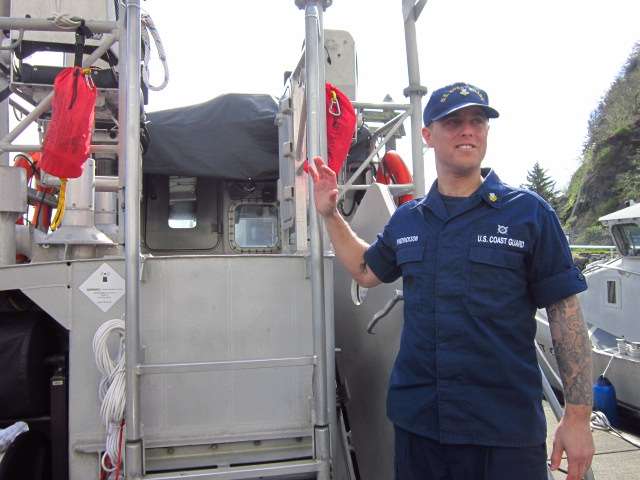
On Board
Then we were handed over to Mark Dobney, former Commander of the Motor Lifeboat School who talked to us about the history of search and rescue in Pacific County beginning with the old Life Saving Service, forerunner to the Coast Guard. By 11:00 we were at Cape D and listening to two surf and rescue experts who are instructors at the School. They were endlessly patient in answering our questions, helping us aboard the 47MLB (the forty-seven foot long Motor Life Boat that can roll completely over and right itself in the water) and explaining its capabilities and their experiences on it.
While we community members were reveling in the sunshine and admiring the calm vistas over Baker’s Bay, the Coast Guardsmen were hoping for better ‘teaching weather’ which, of course, translates into stormy, rough conditions on the Columbia River Bar. The combination of wind, currents and surf that make our part of the Pacific Coast one of the most dangerous maritime areas in the world is the very reason that the National Motor Lifeboat School was established here in 1968. It is the only one of its kind in the nation and is the training ground (or water) for surf rescue personnel from all over the U.S. and from many other countries, as well.
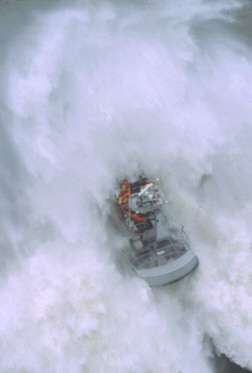
Working Conditions at Cape D
We were treated to a few minutes of film footage which was actually taken during a training session. To me, an inveterate landlubber, even watching the film was terrifying. Fortunately, for their students and for anyone in trouble ‘out there,’ the two young men talking to us not only were knowledgeable, personable, and exuded competence – they both expressed, more than once, how much they loved their jobs and felt so very fortunate to have been chosen to serve at Cape D.
I flashed back on other trips out to the Motor Lifeboat School – field trips with elementary classes who were also awed by the boats and men and film clips. I wondered if any of those youngsters had been inspired by those long-ago visits. I hope so. I, for one, left feeling grateful that such an installation exists right nearby and that modern equipment and rescue techniques, to see nothing of the boundless enthusiasm and expertise of the personnel, has improved our maritime safety record immensely. Perhaps our reputation as “Graveyard of the Pacific” can now be relegated to the history books!
Thank goodness for Coast guardsmen willing to practice rolling their boat and saving lives. I am glad that you didn’t get the rolling treatment!