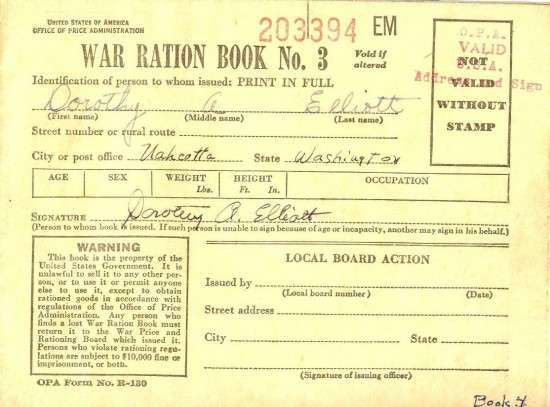
- War Ration Book No. 3

A year or so ago when I was researching information for the “Willapa Camps” issue of the Sou’wester, I came across camp director Dorothy Elliott’s ration books from World War Two. Even though I was only a little girl, I well remember those years of victory gardens and blackouts and, especially, rationing. From 1942 when I was six, until 1946 when I was ten, ration books were an important part of our lives. It was the ration stamps the books contained that determined what we could and couldn’t buy, whether or not we had the money to pay for whatever it was.
Most goods were hard to come by during the 1940s. The nation had mobilized for the war effort and many items were no longer being manufactured; other things were simply not available to civilians. In the spring of 1942, just months after Pearl Harbor, the Food Rationing Program was put into effect, giving the federal government control over supply and demand. Eventually, many more items than food were rationed: tires, cars, bicycles, gasoline, fuel oil and kerosene, solid fuels, stoves, rubber footwear, shoes, sugar, coffee, processed foods, meats, canned fish, cheese, canned milk, fats, typewriters.
Adults were allowed one pair of shoes a year; kids, could get two pairs. I remember shoes because my dad walked about five miles to and from work and he had to have his shoes re-heeled and half-soled fairly often. I’m sure the leather for those repairs was rationed, too. I also remember standing in line to get meat and bread. And I remember that when ships came into the shipyard where my mom worked, they emptied their larders of butter and other leftovers so they could get a full consignment of fresh supplies before shipping out again. Once in awhile mom brought home some of those hard-to-get items.
On the back cover of Miss Elliott’s ration book is a page entitled “Instructions” and at the bottom it says: “If you don’t need it, DON’T BUY IT.” Sixty-five years ago those were words to live by. In our consumer society of today, I imagine most people would be hard pressed to do so.
I wonder how people would have reacted to say, having gas rationed following 9-11. In my own blog I have extolled the virtues of conservation of our physical and financial resources and been accused of being un-American. I am sure that had any discomfort been brought to this century’s American public there would have been an outcry and elections might have been swayed. I don’t know if the current generations would have had the stomach to tighten their belts and do what needed to be done to defeat Germany and Japan. Certainly they are not interested in conserving gas and taking away the Middle East’s most powerful weapon.