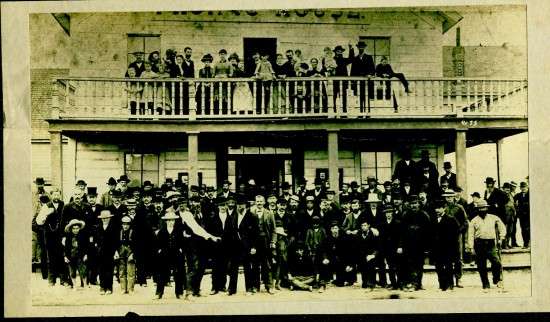
Pacific House circa 1890
My friend, the late Larry Weathers, and I used to argue about how many people lived in Oysterville in its ‘hey-day.’ DeWitt Stoner, an old, old man in my childhood, had come here in 1884 when he was eleven years old. He always claimed there were about 500 people living here then.
“The census numbers just don’t bear that out,” Larry would say. “Besides, every ghost town or place-that-is-no-more claims that they had a population of ‘about 500.’ It simply wasn’t true.”
Though I loved arguing with him, I think Larry was right. Even Pacific City at Cape Disappointment – a community that had barely begun when it was gobbled up by a federal executive order creating Fort Canby Military Reservation – was said to have had as many as 500 people. I have to concede that those numbers are highly unlikely for a town that lasted just a year or two and reportedly had only a store, tavern, sawmill, hotel and several houses.
My counter-argument to Larry was always that Oysterville could have had a population of 500 when court was in session during the years that we served as the County Seat. That was when the lawyers and their clients came to town, filled the boarding houses and hotels – up to 250 people at the Pacific House alone! Or so they say.
Right now, I’m working with the census reports for the early decades of the twentieth century. Those were the days after the County Seat had moved to South Bend, the train only came as far north as Nahcotta, and there wasn’t much going on in the oyster business. Oysterville’s permanent population was dwindling seriously and it was beginning to be referred to in the Seattle newspapers as a “pioneer ghost town.”
Even so, there were 82 residents living in 28 houses in Oysterville in 1920. Of those, 28 were school-aged children – fewer, presumably, than the 1914-1918 years when a second school was opened in town to accommodate the very large student population. At the conclusion of the 1920 report it is noted that there were 27 vacant residences in town.
I wonder if our latest census report will reflect the number of ‘vacant’ houses in town – or at least the ones that were vacant when the census taker was making her rounds. These days, most of those are second homes. Will that be noted?
And, what will someone like me make of our current census data 100 years from now? Actually, only 70 years from now. According to the National Archives and Records Administration, a complete report cannot be released for 72 years following the census. I’m sorry I won’t be around in 2082 to learn what was reported for Oysterville!
0 Comments